
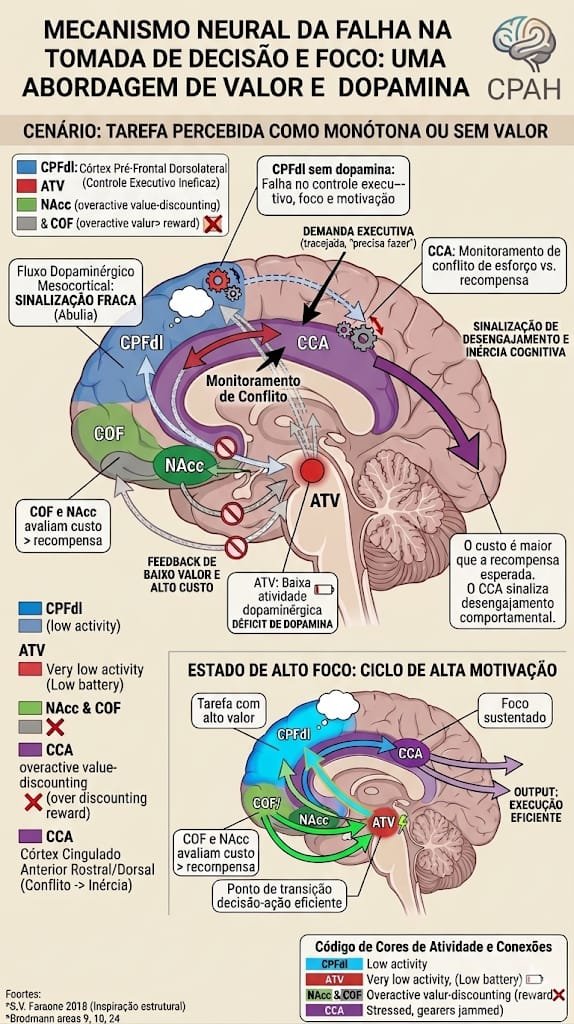
The Dorsolateral Prefrontal Cortex (dlPFC) plays a central role in cognitive management, being fundamental for planning, behavioral organization, and maintaining sustained attention. To operate efficiently, this region depends on adequate dopaminergic modulation, especially in the mesocortical pathways. When dopamine signaling is reduced, executive control is impaired, favoring abulia, difficulty sustaining attentional focus until task completion, and a greater propensity for procrastination.
This functional deficit often emerges from the subjective evaluation of the value attributed to the task. When faced with activities perceived as monotonous or emotionally irrelevant, the Orbitofrontal Cortex (OFC) and the Nucleus Accumbens participate in the cost-benefit analysis and reward expectation. When the activity is interpreted as not very salient or insufficiently rewarding, the stimulus on the Ventral Tegmental Area (VTA), one of the main origins of mesocorticolimbic dopaminergic projections, is reduced. As a consequence, the neurochemical support necessary to sustain motivation, cognitive engagement, and behavioral persistence decreases.
In this process, the Anterior Cingulate Cortex (ACC) acts as a critical interface for monitoring conflict and allocating mental effort. The ACC integrates the tension between the executive demands of the dPFC (“the task needs to be done”) and the low emotional value assigned by the OFC (“the task does not generate immediate interest”). When the cognitive cost is perceived as greater than the expected reward, the ACC tends to signal reduced behavioral engagement, hindering the transition between intention and practical execution. The result is a state of cognitive inertia in which the individual retains awareness of the obligation but has difficulty converting decision into action.

Dr. Fabiano de Abreu Agrela Rodrigues MRSB holds a post-PhD in Neuroscience and is an elected member of Sigma Xi – The Scientific Research Honor Society (more than 200 members of Sigma Xi have received the Nobel Prize), as well as being a member of the Society for Neuroscience in the United States, the Royal Society of Biology and The Royal Society of Medicine in the United Kingdom, the European Society of Human Genetics in Vienna, Austria, and the APA – American Philosophical Association in the United States. He holds a Master’s degree in Psychology and a Bachelor’s degree in History and Biology. He is also a Technologist in Anthropology and Philosophy, with several national and international degrees in Neuroscience and Neuropsychology. Dr. Fabiano is a member of prestigious high IQ societies, including Mensa International, Intertel, ISPE High IQ Society, Triple Nine Society, ISI-Society, and HELLIQ Society High IQ. He is the author of more than 300 scientific studies and 30 books. He is currently a visiting professor at PUCRS in Brazil, UNIFRANZ in Bolivia and Santander in Mexico. He also serves as Director of CPAH – Centro de Pesquisa e Análises Heráclito and is the creator of the GIP project, which estimates IQ through the analysis of genetic intelligence. Dr. Fabiano is also a registered journalist, having his name included in the book of records for achieving four records, one of which is for being the greatest creator of characters in the history of the press.